You Won’t Believe What I Found in the Hidden Markets of Ouarzazate
Tucked between desert dunes and ancient kasbahs, Ouarzazate holds secrets most travelers never see. Beyond the film studios and tour buses, real magic hides in its quiet alleyways—vibrant markets where artisans sell handcrafted treasures. I stumbled upon these spots by chance, and what I discovered changed how I view Moroccan shopping forever. This isn’t about souvenirs for tourists—it’s about authenticity, craftsmanship, and the thrill of finding something truly rare. In a world where so much travel feels curated and commercial, Ouarzazate offers something different: a chance to connect with tradition, to witness skill passed through generations, and to bring home not just objects, but stories. For women who travel with intention—those who seek meaning over merchandise—this is a destination that speaks softly but lingers deeply.
The Gateway to the Sahara’s Best-Kept Secrets
Ouarzazate, often dismissed as a transit point on the road to the Sahara, is in fact a cultural crossroads that pulses with quiet strength. While cities like Marrakech dazzle with their intensity and Fes overwhelms with its labyrinthine medina, Ouarzazate unfolds at a gentler pace. It doesn’t shout for attention; instead, it invites you in with open arms and sun-warmed stone walls. The city’s unique position—nestled between the High Atlas Mountains and the edge of the desert—has made it a meeting place for Berber communities, Arab influences, and colonial history, all of which are visible in its architecture, language, and daily rhythms. This blend creates an atmosphere that feels both timeless and lived-in, where tourism hasn’t erased local life but exists alongside it.
Because it’s less crowded than Morocco’s more famous destinations, Ouarzazate allows for a kind of travel that’s increasingly rare: slow, observant, and personal. You can walk through the older neighborhoods without feeling like part of a herd. There are no long lines to enter ancient gates or jostling for space in narrow alleys. Instead, you’re likely to be greeted with a nod or a quiet “Salam alaikum” from a shopkeeper arranging baskets of dried apricots in the morning light. This ease of movement and openness makes it ideal for travelers who want to explore without pressure, especially those who appreciate a more thoughtful, reflective journey.
Its reputation as the “Hollywood of Africa” due to the Atlas Studios attracts film enthusiasts, but that’s only one layer of its identity. The real heart of Ouarzazate beats in its backstreets, where daily commerce continues much as it has for decades. These are not spaces designed for Instagram moments or souvenir hunters—they’re where families come to buy bread, where women select fabric for new dresses, and where elders sip mint tea while discussing the weather and the price of saffron. To experience this side of the city is to witness Morocco not as a performance, but as a living, breathing culture. For women who travel with care—often balancing family needs with personal curiosity—this kind of authenticity is not just refreshing; it feels like a gift.
Stepping Off the Beaten Path: Where the Real Market Life Begins
Just a short walk from the central square, away from the souvenir shops selling camel-shaped keychains and mass-produced lanterns, the true market life of Ouarzazate begins. The shift is subtle but unmistakable. The air changes—no longer just dust and diesel, but layered with the earthy scent of cumin, the sweetness of dried figs, and the faint tang of raw wool. The sounds deepen too: the rhythmic tapping of a coppersmith’s hammer, the low hum of conversation in Tamazight, the occasional burst of laughter from a group of children weaving between stalls.
These are not the markets featured in glossy travel brochures. They’re not even marked on most tourist maps. But they’re where the city’s soul lives. One morning, guided only by the smell of baking bread, I turned down a narrow lane and found myself in a cluster of small workshops. A man shaped tagine pots with practiced hands, his fingers moving like water over the clay. Next door, a woman sorted bundles of saffron and henna, her hands stained yellow from years of handling spices. There was no signage, no price tags, and certainly no pressure to buy. When I paused to look, she smiled and offered a pinch of saffron to smell—no transaction required.
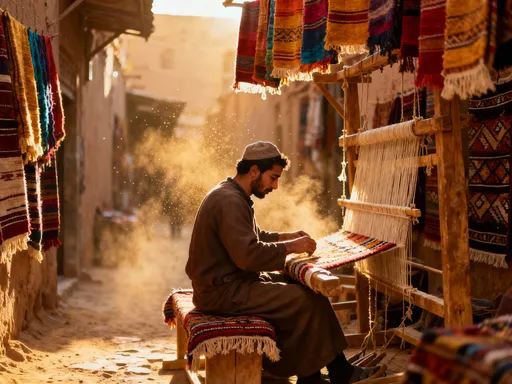
It was in one of these alleyways that I met Fatima, a carpet weaver whose family has worked with wool for five generations. Her workspace was simple: a low wooden loom set beneath a shaded courtyard, sunlight filtering through a lattice screen. As she worked, her fingers flew, knotting threads with precision that came only from a lifetime of practice. She explained that each pattern told a story—some represented protection, others fertility or the journey of life. Her daughter sat nearby, learning the craft, her small hands already beginning to mimic the movements. This wasn’t a performance for tourists; it was her life’s work, unfolding in real time.
What struck me most was the absence of sales pressure. No one shouted for attention. No one followed me down the street. Instead, there was a quiet dignity in the way people went about their work. When I showed interest, I was welcomed—not as a customer, but as a guest. This kind of interaction, built on respect rather than transaction, is rare in more commercialized destinations. For women who value meaningful connection over checklist tourism, these moments are not just memorable—they’re transformative.
The Craftsmanship Behind the Goods: More Than Just Shopping
In Ouarzazate’s hidden markets, every object carries a history. A hand-carved wooden box isn’t just a container; it’s the result of hours of patient work, shaped with tools passed down from father to son. A hand-dyed rug isn’t merely decorative; it’s a map of memory and meaning, woven with natural pigments from plants grown in the surrounding valleys. These items are not made quickly or cheaply. They are born of tradition, skill, and an intimate relationship between maker and material.
I spent an afternoon with Abdelkrim, a potter who uses clay sourced from the Draa Valley, just a few hours’ drive from the city. He takes his time selecting the right soil, mixing it with sand and water until it reaches the perfect consistency. His hands, cracked and calloused, move with confidence as he shapes each tagine on a foot-powered wheel—a technique unchanged for centuries. “This is not factory work,” he told me, wiping his brow. “Each piece listens to the hands that make it. If you rush, it breaks. If you respect it, it lasts.” His words stayed with me, a reminder that true value isn’t measured in speed or scale, but in care and continuity.
Supporting artisans like Abdelkrim does more than add beauty to a home—it helps preserve a way of life. In an age where mass production dominates, handmade goods are acts of resistance. They represent time, patience, and cultural identity. When you buy a hand-beaded slipper or a hand-embroidered cushion, you’re not just purchasing an item; you’re helping sustain a craft that might otherwise fade. For women who often manage household budgets with care, this kind of spending can feel deeply purposeful. It’s not indulgence—it’s investment in people, in heritage, in the quiet dignity of skilled labor.
Moreover, these artisans are often part of family-run businesses that depend on consistent, fair trade. A woman who sells homemade argan oil may use the income to send her children to school. A young man carving wooden doors may be saving to open his own workshop. Every purchase, when made with awareness, becomes a small act of support. This isn’t charity—it’s partnership. And in a world where so much feels disposable, choosing to buy something made to last—both in quality and meaning—can be a powerful statement of values.
What to Look For (And What to Skip)
Not every stall in Ouarzazate offers authentic craftsmanship. As tourism grows, so does the presence of imported goods disguised as local art. You’ll find plastic “leather” bags, machine-printed “handmade” rugs, and bottles of fake argan oil made with cheap oils and food coloring. Learning to spot the difference isn’t just about getting your money’s worth—it’s about ensuring your support goes to the right hands.
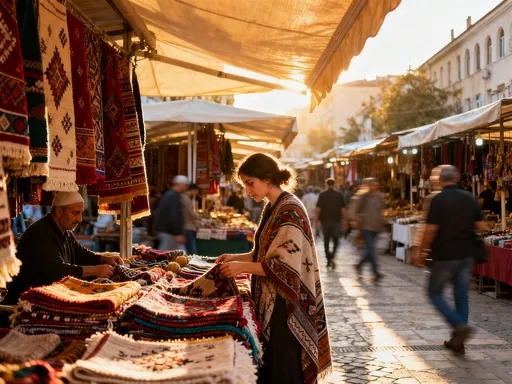
Start with textiles. Real handwoven rugs will have slight imperfections—uneven knots, minor color variations—because they’re made by hand, not machine. The back of the rug should look as detailed as the front. If it’s too perfect, it’s likely factory-made. Natural dyes also behave differently than synthetic ones; they age gracefully, softening over time rather than fading harshly. Ask the artisan if they use plants like indigo, saffron, or pomegranate to dye their wool. Many will gladly show you the dye pots or even name the mountains where the plants grow.
When it comes to leather, trust your nose. Genuine Moroccan leather has a distinct, earthy smell—rich and slightly smoky. If it smells like plastic or chemicals, it’s not real. Also, look for hand-stitching and natural variations in color and texture. Machine-made goods are uniform; handmade ones breathe with character. For argan oil, always check the packaging. Authentic oil is stored in dark glass bottles to protect it from light, and it’s never cheap. If a vendor is selling “pure argan oil” for a few dollars, it’s almost certainly diluted. True argan oil is labor-intensive to produce—women in cooperatives hand-crack each nut and cold-press the kernels—so its value reflects that effort.
As for pricing, haggling is expected but should be done with respect. Start by asking the price, then offer about 60% of that, and meet somewhere in the middle. But remember: these artisans aren’t trying to get rich off tourists. They’re making a living. Paying a fair price isn’t losing a negotiation—it’s honoring their work. If a price feels too high, walk away politely. There’s no shame in not buying. What matters is approaching the exchange with dignity on both sides.
Beyond the Souks: Open-Air Markets and Seasonal Stalls
While the covered souks offer shelter from the midday sun, some of the most vibrant market life happens outdoors, especially on certain days of the week. Every Friday morning, on the outskirts of Ouarzazate, a temporary market springs to life. Farmers from nearby villages arrive before dawn, unloading donkey carts filled with dates, olives, and fresh vegetables. Women set up cloth-covered tables displaying homemade henna, dried herbs, and jars of preserved lemons. It’s less polished than the city center, but infinitely more alive.
I arrived just after sunrise and was immediately drawn to a spice merchant who stood behind a wooden table layered with bowls of crimson paprika, golden turmeric, and deep brown cumin. He wasn’t selling pre-mixed blends in jars. Instead, he created custom mixes for his customers, adjusting ratios based on their needs—more heat for one family’s tagine, extra aroma for another’s couscous. When I asked what he recommended, he didn’t push a tourist package. He asked how I cooked, what I liked, and then blended a small bag just for me. “This is for your kitchen,” he said with a smile. “Not your suitcase.”
These seasonal markets offer a glimpse into the rhythm of daily life. You won’t find postcard racks or English signage here. Instead, you’ll see mothers comparing prices on dried figs, elders testing the ripeness of melons, and children sneaking bites of fresh bread. The goods are simple but deeply rooted in place: argan nuts still in their shells, hand-thrown tagines with rough edges, bundles of thyme gathered from the hills. There’s a humility to these items, a sense that they exist to serve, not to impress.
For women who appreciate home cooking and natural ingredients, these markets are a treasure. You can buy spices by the handful, sample fresh olive oil on a piece of bread, or learn how to use dried mint in tea from a vendor who’s been doing it for forty years. It’s shopping as conversation, as education, as connection. And because these markets are less tourist-focused, prices are fair and interactions are genuine. This isn’t about collecting souvenirs—it’s about gathering pieces of a lifestyle that values simplicity, seasonality, and care.
How to Get There Without a Tour: Local Transport Tips
One of the most empowering things about visiting Ouarzazate’s hidden markets is that you don’t need a guided tour. While group excursions have their place, independent travel allows for spontaneity and deeper engagement. The city is compact enough to navigate on foot, and locals are generally friendly and willing to help. A simple gesture, a few words of Arabic or French, and a warm smile can go a long way.
Petit taxis are the most convenient way to reach areas outside the center. These small, often brightly colored cars are metered, but it’s wise to confirm the approximate fare before starting your journey. For short trips within the city, expect to pay between 10 and 30 Moroccan dirhams, depending on distance. If you’re heading to the Friday market on the outskirts, you can either take a taxi directly or ride a local “grand taxi”—a shared vehicle that follows set routes. These are cheaper and offer a more authentic experience, though they may require some patience and flexibility.
Walking is often the best way to discover hidden spots. Even if you get turned around, wandering with confidence usually leads to interesting encounters. I once took a wrong turn and ended up in a quiet courtyard where an elderly woman was teaching her granddaughter to embroider. We shared tea and gestures, and though we spoke different languages, the moment felt deeply connected. Locals appreciate when visitors show respect—dressing modestly, asking permission before taking photos, greeting shopkeepers before browsing. These small courtesies open doors more than any guidebook ever could.
For women traveling alone or with family, Ouarzazate is generally safe and welcoming. The pace is slow, the people are calm, and there’s a sense of community that makes solo exploration feel comfortable. You don’t need to speak fluent Arabic or French to get by—basic phrases and a patient attitude are enough. And remember: getting lost isn’t a failure. Sometimes, it’s the beginning of the best part of the journey.
Why These Hidden Markets Matter—And How to Respect Them
The hidden markets of Ouarzazate are more than shopping destinations—they are living ecosystems of culture, economy, and tradition. They matter because they keep ancient crafts alive, support family livelihoods, and preserve knowledge that might otherwise disappear. But their survival depends on how visitors choose to engage. Ethical tourism isn’t about taking the perfect photo or finding the cheapest deal. It’s about showing up with humility, curiosity, and respect.
When you take a photo of an artisan at work, ask first. A simple hand gesture or “May I?” goes a long way. If they say no, accept it gracefully. These are not performers; they are people doing their jobs. When you haggle, do it with a smile and a sense of fairness. Remember that the price you’re negotiating isn’t just about profit—it’s about feeding a family, paying for school supplies, or repairing a roof. Walking away from a price that feels too high is fine, but never mock or belittle the work.
Most importantly, slow down. Put the phone away. Listen more than you speak. Let yourself be surprised by a shared cup of tea, a spontaneous lesson in dyeing wool, or the sound of a loom clicking in the afternoon sun. These are the moments that stay with you long after the trip ends. For women who often carry the weight of planning, packing, and managing family needs, this kind of presence—simple, unscripted, heartfelt—is a rare gift.
True travel isn’t about ticking off landmarks. It’s about opening your heart to places like Ouarzazate, where the golden light of late afternoon falls across quiet market stalls, where craftsmanship is a form of storytelling, and where every purchase can be a quiet act of preservation. In these hidden corners, you don’t just find souvenirs. You find connection. And sometimes, if you’re lucky, you find a piece of yourself waiting there too.